Well, you know what it’s like… you plan for it, you shop for it, you tear your hair out for it and, at the end of the day, you find it’s December 27th and once again, Christmas is just a memory. But as long as it’s a good memory, who’s worried!
In France the “big dinner” is the evening of December 24th and M-D and I had planned a quiet dinner together since we were heading down to Orleans the following day to have a ‘second Christmas’ with M-D’s daughter and grandaughters. However, the best laid plans etc…. and a few days before, we discovered that a friend would be on his own for Christmas so we invited him over for Christmas Eve dinner with us.
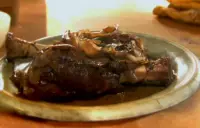 It had to be simple and straightforward, so we opted for foie gras as a starter, Rich Gravy Lamb as the main course, cheese and salad and then we finished on M-D’s (in)famous Citrus Parfait which we always have ready in the freezer.
The Rich Gravy Lamb is an absolute stunner because it is stupidly simple to prepare – lamb (leg or shank), a couple of onions, a bit of stock and red wine, a few simple herbs and a fillet or two of anchovies (yep, you read that right … anchovies. Though you can’t taste them in the finished dish, they totally transform the meat and gravy, bringing out all the delicious flavours). The joy of it is that you shove it in a slow oven and leave it alone until you’re ready to eat it. It also washes down quite well with a 1986 Roc du Breuil, Cotes de Bourg!
The following day, we drove down to Orleans (it’s about 100 miles) and met up with Muriel and the girls (Clélence and Eléonore). They had spent Christmas with Muriel’s half-sister over on the Atlantic coast so they had driven for about 3-4 hours to get home. Nonetheless, along with Muriel’s Grandmother, Rolande (96 going on 25), we made up a happy gang of six.
We started with Julie’s Salmon & Prawn with Lime which has, in just the few months since our neighbour in Peel introduced us to it, become one of our firm favourites. We already had them drooling and we hadn’t even arrived at the pièce de résistance…
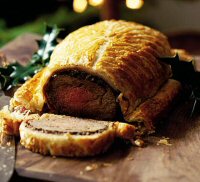 The day before, I had prepared a Beef Wellington to the stage that the fillet of beef was wrapped in its coat of mushroom duxelles and Parma ham. So all I had to do at Muriel’s was to add it’s pastry overcoat (two packets of ready-rolled puff pastry), coat with egg yolk, and pop in the oven for about 40 minutes (it was a 2¾lb – 1.25kg fillet). It came out perfectly cooked to suit us all. The ends were medium-well, the centre was rare and in between a beautiful medium rare, so everybody got what they wanted. (In fact we all got we wanted two days later, too …. left-overs. Cold. With Salad. And a few miniature tomatoes. Bliss!). Helped down with a rather splendid 1986 Chateau Moulin a Vent, Lalande de Pomerol, I can highly recommend Beef Wellington, hot or cold!!
And now we’re back home in Acheres planning the next onslaught!!! Today is Friday (for about another hour) and tomorrow we dive to the shops and get what we need for the next few days because M-D’s sister, Christine, is arriving for a week or so. On Sunday we are having a “late Christmas” dinner with Christine and “Tatty Suzanne” (Christine and M-D’s aunt who lives a few miles away on the outskirts of Versailles.). The plan is for Monk Fish in Orange which is a bit of a mixture of two other recipes but, if it works, should be pretty damn good!
I’ll let you know (or not!)
 We kicked off with a starter that our neighbours, Julie and Terry, on the Isle of Man had made for us just before we came back to France…
 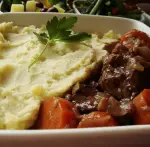 Our main course was
 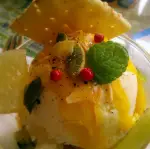 After the cheese, we finished off with M-D’s famous
  First of all, the name Cavellec is typically Breton (from Brittany on France’s Atlantic coast). Secondly, Bruno was a really approachable guy with an easy-going manner and a contageous smile. Third, being French, he and Marie-Danielle could stop talking English for a few minutes and relax into their own language. And fourth, I fell in love with (and bought a copy of) his giclée print “
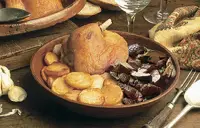 And, if it’s worth doing, it’s worth overdoing, so we carried on with the duck theme and served
 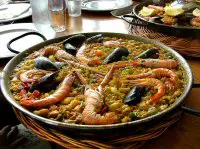 We decided on a
 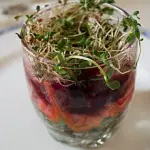 The verrines we made were stupidly simple. The first was tomato with fresh goat’s cheese. We placed two 400g tins of chopped tomatoes into a pan, crushed in a garlic clove and a bit of salt and freshly ground pepper, then brought it to a gentle rolling boil until all the juice had evaporated and only the pulp was left. This, we left to chill. Once cold, we placed about two teaspoons of the tomato pulp into the bottom of each glass. On top of that we crumbled about 1-1½ teaspoons of fresh goat’s cheese which we had broken up with a fork. Drizzle a tiny bit of olive oil over each and dress with chopped fresh basil – and yummy … lovely as an apperitif or, as we did, with a tapas selection.
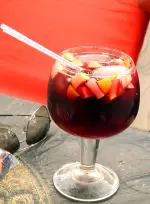 All of this, of course, was washed down with several decent-sized glasses of sangria which M-D had made three days earlier (it tastes better when it’s prepared in advance). Depending on your guests’ ability to quaff the fruit of the vine, you can change these quantities to suit yourself. This time, there were just four adults but I know that both Terry and I can manage our way to the bottom of the glass without too much difficulty! So we used 3 x 750ml bottles of 14.5% red wine (a rather palitable Bordeaux – 2010 Coteaux du Languedoc called L’Ame des Schistes). The actual recipe is as follows (ingredients below are for 1 litre of red wine. For 4 people, use at least 2 bottles, i.e. 1.5 litre – quantities of fruit etc. can then be adapted accordingly). Since the fruits in particular are going to water down the sangria, the wine used should be at least 13% volume. Never use the so-called “sangria mixes” to do this recipe, since they are already watered down.
 The Isle of Man is only about 36 miles x 12 miles at its longest and widest points. Today, about 85,000 of us perch on this rock in the middle of the Irish Sea, and every summer we are subjected to hundreds of motorbikes racing through the streets of our towns and villages and around the island on the 37.7-mile Snaefell Mountain Course. Their average speed is over 130 mph and in places they exceed 200mph!
 Never mind the visitors, the TT races themselves are extremely dangerous (over 250 rider deaths to date on this circuit). Imagine riding at over 200 mph on tiny, narrow, twisting streets, roads and lanes flanked by stone walls and buildings, dodging manhole covers and stray dogs! Some, including a few former competitors, have called for the race to be banned, but for the most part the riders love the TT. They know it’s dangerous, but they also know it’s the absolute pinnacle of motorcycle racing. It’s the ultimate, and if you’re good enough – and you’re brave enough – then you go for it, regardless of the risks. Personal responsibility and the love of speed triumph the desire for safety here.
 Oh yeah – I almost forgot about “Mad Sunday.” One day every year at the TT, they open up the 37 mile course to the public. That means anyone on a motor bike can try his or her luck trying to match the professionals for speed (and insanity!). Imagine, if you can, a Formula 1 or NASCAR event where they let 50,000+ fans onto the track, charging around in whatever vehicle they came in. In recent years, to try and reduce the carnage (and maybe also to give the visitors even more thrills!) the roads have been made one-way for about 8 miles over the mountain section of the course. Big, powerful road bikes hitting their top speeds of 170mph-180mph is not unusual on this section.
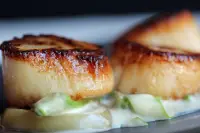 Last Saturday evening, we invited our neighbours, Terry and Julie plus Dominic and Kate from over the road for a meal. We decided to mix the best of the Isle of Man with the best of France (as you do!) so (after polishing off a couple of bottles of Champagne with the aperitif) we started the meal with one of our favourites – beautiful fresh Manx scallops, and prepared the excellent
 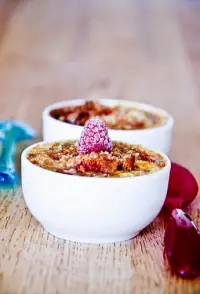 As we always do, we served the meal French style (dessert last) and I dug around in M-D’s wine cooler and came up with a really nice bottle of 2008 Côtes de Bergerac. The Côtes de Bergerac is a deeply smooth sweet white wine that complimented our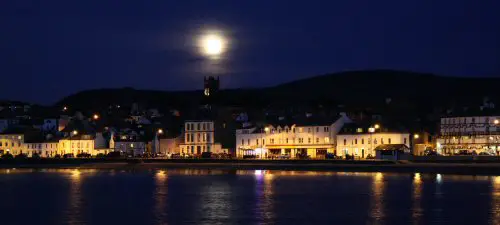
 However, one place that never fails to please is
 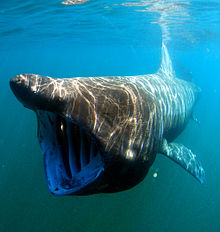 As we were out walking the other day, we met one of the local “characters” – a lady by the name of Pauline who, it turns out, is involved in the monitoring of Basking Sharks, which are often found in the plankton-rich waters around the Isle of Man. The Basking Shark is the second biggest fish in the world (second only to the Whale Shark) but it is truly an endangered species. It is a slow moving filter feeder that has a greatly enlarged mouth and highly developed gill rakers. These enormous fish have been measured up to 12.27 metres (40.3 ft), and weighing an estimated 19 tonnes, yet these gentle giants are not aggressive and are harmless to people.
 Naturally (as you do) we kicked off with a couple of bottles of fine Vranken Champagne Demoiselle Brut Premium Cuvée (it helps wash down the apperitif biscuits and olives!!)
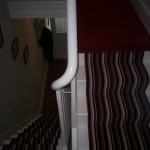
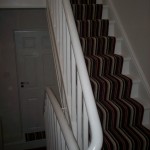
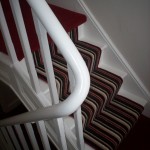
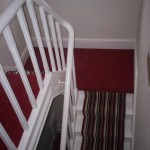
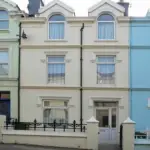 We’re heading back to The Isle of Man in a few days. We’ll be there for a couple of months, but we probably won’t get much relaxation! We bought a three story Victorian town house in August 2011 and it came complete with ivory-coloured fluffy carpets throughout! We have replaced the ground floor with parquet but the stairs and two floors of bedrooms still need to have something done to get rid of the ghastly dust trap underfoot! Our plan is to dump the carpets, strip the pine boards back to original state, tint them just to help the colour a little, then apply a matt varnish. On the stairs and landings, we’ll get new carpet runners and paint the edges white (a bit like it would have been originally except maybe the colour).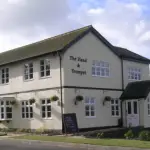
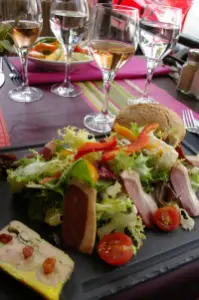 Last Saturday evening, we had a dinner for six of us. In addition to M-D and myself, there was Loius and Monique who live close by and keep an eye on the apartment here while we are on The Isle of Man, Jean-Luc who was a neighbour until recently, and is now living in Brittany and Pascale, a new neighbour who bought his apartment from him. We decided to keep it simple so I produced that gastronomic delight,
 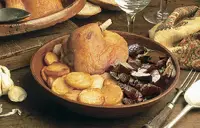 We followed up with a traditional French dish,